Swaraj Polycoats
Why Surface Preparation is Key Before Any Paint Job?
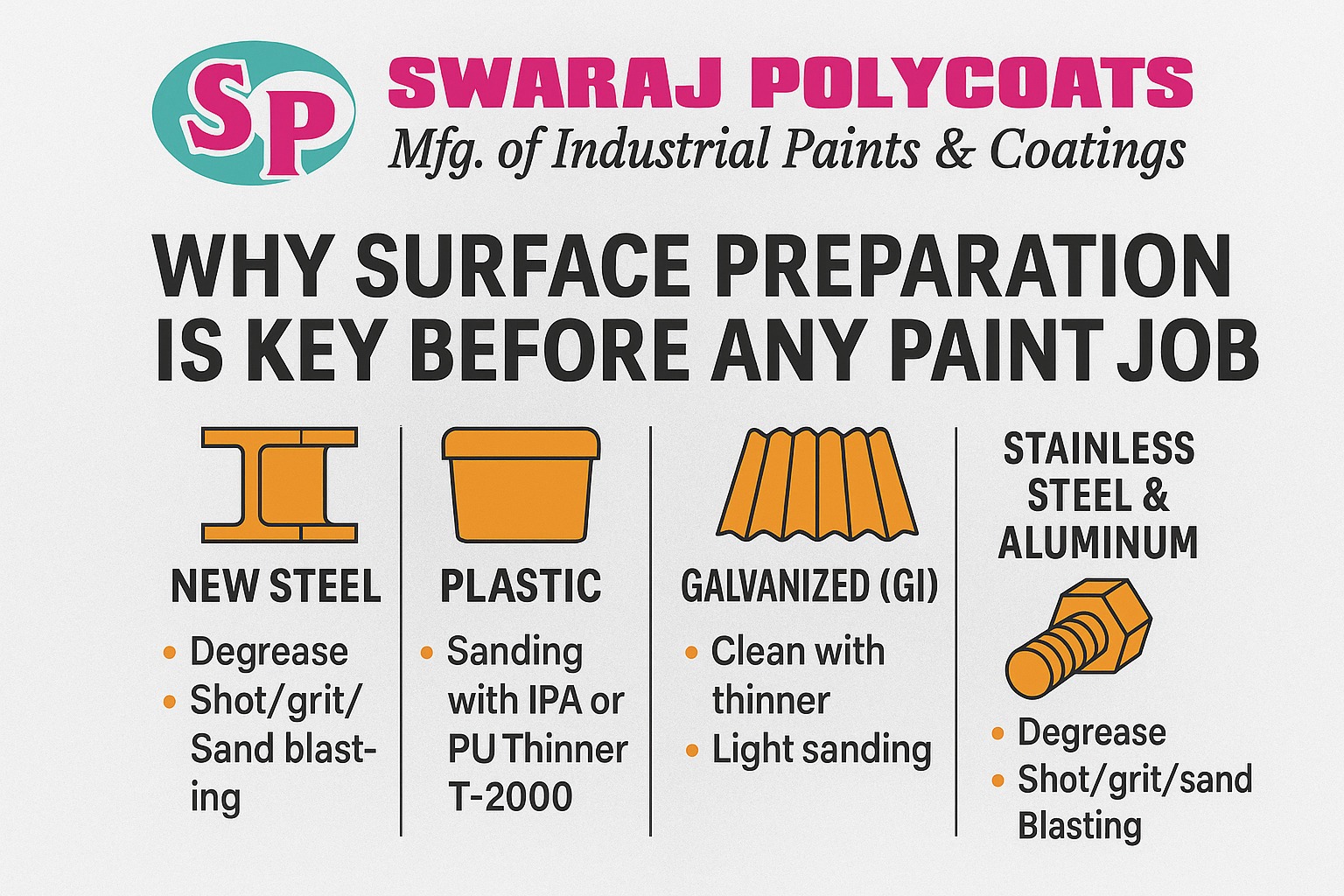
In industrial and commercial painting, the quality of a finish is not just about the paint—it's about what lies beneath it. Surface preparation is the unsung hero that ensures long-lasting adhesion, corrosion resistance, and an aesthetically appealing coat. At Swaraj Polycoats, a leading name in industrial paint and coating solutions in India, we emphasize that even the most advanced polyurethane or epoxy system will fail if the surface isn't properly prepared.
Let’s explore how various substrates should be prepped before painting for maximum performance.
1. New Steel Surfaces (CRCA, MS, HR, Cast Iron)
Steel surfaces typically have mill scale, rust, and contaminants. The ideal preparation method includes:
- Degreasing with paint thinner to remove oil, grease, and salts.
- Blast Cleaning (Sa 2½ as per ISO 8501-1) using grit, shot, or sand.
- Phosphating (7/9 tank method) as an alternative when blasting is not possible.
Once blasted, check that the surface profile is between 25–30 microns. The Dry Film Thickness (DFT) of the paint should be at least 3 times this profile (i.e., 90–100 microns) for optimal protection.
2. Plastic Substrates (ABS, Acrylics, PVC, PP, FRP)
Plastics must be gently sanded to remove burrs and promote adhesion. Use emery paper and clean the surface using IPA (Isopropyl Alcohol) or PU Thinner T-2000. Always test for compatibility to avoid surface damage.
3. Galvanized (GI) Substrates
Galvanized iron has a very smooth finish that resists adhesion. To prepare it:
- Remove oil, grease, and contaminants using thinner.
- Light sanding with emery paper (No. 220) helps roughen the surface, improving coating grip and durability.
4. Stainless Steel and Aluminium Substrates
These are difficult to coat due to their smoothness. Recommended methods include:
- Degreasing with thinner.
- Blast cleaning for best results.
- If blasting isn’t possible, use emery paper No. 150 and 220 for thorough sanding and roughening.
This ensures strong adhesion of primers and topcoats for long-term protection.
5. Old Painted Surfaces
Repainting requires careful evaluation:
- First, clean oil, grease, and dust with thinner.
- Check adhesion using a crosshatch test. If old paint is peeling, remove it completely with abrasion or chemical paint remover, then re-clean.
- If old paint is intact, sand it with emery paper (No. 150 & 220) to roughen the surface for better adhesion of the new layer.
Conclusion
Proper surface preparation is essential to the success of any paint application. Whether you're working with steel, plastic, GI, aluminum, or already painted surfaces, the first step to a professional finish starts with cleaning and conditioning the substrate.
At Swaraj Polycoats, we provide not just high-performance coatings but also technical expertise in surface preparation and application methods. Trust us to help your coatings last longer and perform better—right from the foundation.
Need expert surface coating solutions? Visit 👉 www.swarajpolycoats.com or email swaraj.polycoats@gmail.com for tailored recommendations.